Eclipse DMS
Parts, accessories and whole goods from Eclipse to your store and eBay, with orders flowing back.
Ecommerce and ERP integration for dealers, distributors and B2B businesses, connecting your DMS, inventory and accounting systems to your online store.
A person in the middle is not a system. If someone on your team spends their day copying orders, stock and prices from one screen to another, that's the problem we fix.
20+
Years building ecommerce and integrations
2.5M+
Parts live on Suzuki Australia's national platform
100+
Custom integrations delivered
9
Business systems we integrate with every day
Ecommerce integration connects the system that runs your business (your DMS, ERP or inventory platform) to the places you sell (your website, trade portal, eBay). Stock, prices and products flow out. Orders, customers and payments flow back. Your accounts stay in step.
You've probably felt what happens without it. The website says in stock when it isn't. A trade customer sees the wrong price. Friday afternoon disappears into reconciling. We've been building these connections for 20+ years, and believe me, the relief when the copying stops is real.
Pick your system to see what we connect and how.
Parts, accessories and whole goods from Eclipse to your store and eBay, with orders flowing back.
Customer pricing matrices, stock across locations and orders straight into Exo.
Stock, pricing groups and sales orders in sync between Unleashed and your store or portal.
Cin7 Core and Omni connected to custom stores, trade portals and marketplaces.
Every order a correct Xero invoice, with GST, payments and refunds handled.
Orders in, invoices out, for businesses running QuickBooks Online.
AMwin connected to online ordering and ecommerce, without the manual handling.
Ease business software linked to custom ecommerce and ordering platforms.
Odoo connected to custom stores, eBay and trade portals, including stores moving across from another ERP.
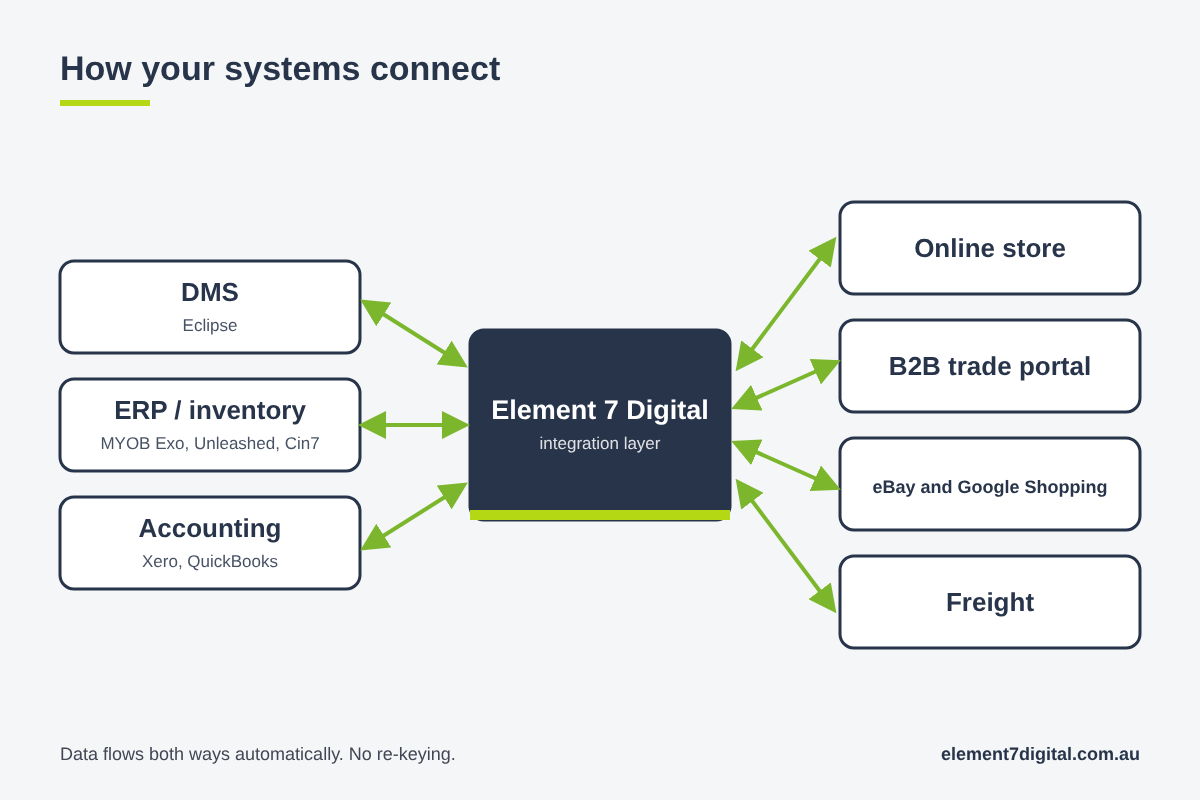
Your DMS, ERP, inventory and accounting systems on one side. Your store, trade portal, marketplaces and freight on the other. We build the layer in between, so data moves both ways on its own and nobody sits in the middle re-keying it.
The same data, pushed to every place you sell, ship and get paid from.
One source of stock and pricing, published to eBay and other channels.
Product feeds built from your DMS or ERP data, not a spreadsheet.
Quoting, booking and labels built into the order flow.
Customer and order data synced to your email and marketing tools.
Checkout payments linked to the order, with payment status, refunds and transaction references flowing back automatically.
Trade customers ordering online at their own price, straight into your ERP.
Get those right and the build is the easy part.
Patrolapart, the Nissan Patrol parts specialist, ran two ecommerce websites (Patrolapart and Navarapart), two eBay stores, automated freight quoting and booking, label printing and order import into MYOB Exo, all from one admin panel, with one staff member.
And at the other end of the scale, we built Suzuki Australia's national parts platform: 2.5 million motorcycle spare parts, pushed live on one integrated system.
Most integration projects run 8 to 16 weeks from sign-off to go-live. Projects start from $12,000.
We map your systems, your data and where the manual work is hiding.
What connects, how often, how failures are handled, and the go-live date, in writing.
Built against a copy of your data and tested with real orders before it touches anything live.
Switched on, watched closely, and looked after as your systems change.
It means your ERP (the system that runs stock, pricing, orders and accounts) shares data automatically with your other systems. For ecommerce, products, prices and stock flow from the ERP to the store, and orders flow back, so nobody re-keys anything.
We work every day with Eclipse DMS, MYOB Exo, Unleashed, Cin7, Odoo, Xero, AMwin, Ease and QuickBooks, plus eBay, Google Shopping, Shippit and other freight platforms, Adyen and PayPal payments, and email marketing tools. For anything else, we check its API or data export first. If the data has a way out, we can usually work with it.
Often, yes. Many systems can export files on a schedule (CSV or XML over SFTP), and we build a reliable integration layer around those.
Three things. Which system is the source of truth for each piece of data. How clean that data is today. And what should happen when something fails. We work through all three on the scoping call, before anyone writes code.
Most integration projects run 8 to 16 weeks from sign-off to go-live, depending on how many systems are involved. Projects start from $12,000. We support everything after go-live as your systems and business change.
Book a scoping call. Tell us about your setup and we'll tell you straight what's possible. No jargon, no obligation.